New Work

New work: Bubble lacy vase

This piece continues my exploration of lacy vases, shifting the visual language to circles. The overlapping circles in the painted design are reminiscent of the circles that bubbles leave behind on a surface and have a more playful feel than a lot of my work. All of the circles, in both the lace and the painted pattern, were hand-drawn free-form, so there are small inconsistencies and imperfections. Similar to the Sunburst lacy vase, the shape of the vase also echoes the round shapes in the painted and lacy textures. The shape is also a play on shapes common in scientific glassware, playing off of my multiple interests in art and science.

I’ll have one more piece in this mini-series to post soon.

Bubble lacy vase
Bubble lacy vase

New work: Bubble lacy vase Read More »

New work: Sunburst lacy vase

This piece is a continuation of my lacy vase series, continuing the theme of creating complementing paint and lace patterns. Unlike the last form based on waves and curves, this piece is based on a sharper, more angular geometry. As the vase widens in the middle, a painted pattern of bright angular brushstrokes emerges from underneath the black lacy panels. The lace cutouts, the painted pattern, and the overall shape of the vase all reflect similar angularity. However, similar to my previous piece, the painted pattern gives a softer version of the same visual language as the lace does.

I’ll be continuing to explore similar themes in my next two posts.

Sunburst lacy vase
Sunburst lacy vase

New work: Sunburst lacy vase Read More »

New work: Wavy lacy vase

I’m catching up on posting some pieces from several years ago that I never posted when I folded them. This piece is a continuation of my lacy vase series, continuing to play with the contrast between a black lacy pattern and a contrasting painted section. The new element here is that instead of leaving the non-lacy sections white, I painted them in a pattern reminiscent of water the complements the wavy patterns in the lace.

Wavy lacy vase
Wavy lacy vase

The lace pattern and the painted pattern represent the flow of water in different ways: the painted section represents it in gradations of color, but the cuts of the lace represent it in fluid curves. Unlike most of my pieces, there are no folds that cross the central lacy section, so the lace is able to flow smoothly all the way around the vase without any interruptions.

I’ll be posting the continuation of this mini-series soon, with several other pieces that explore the connection between painted patterns, lace patterns, and the overall form of the vase.

New work: Wavy lacy vase Read More »

New work: Cone-based inward/outward diagonal shift vase

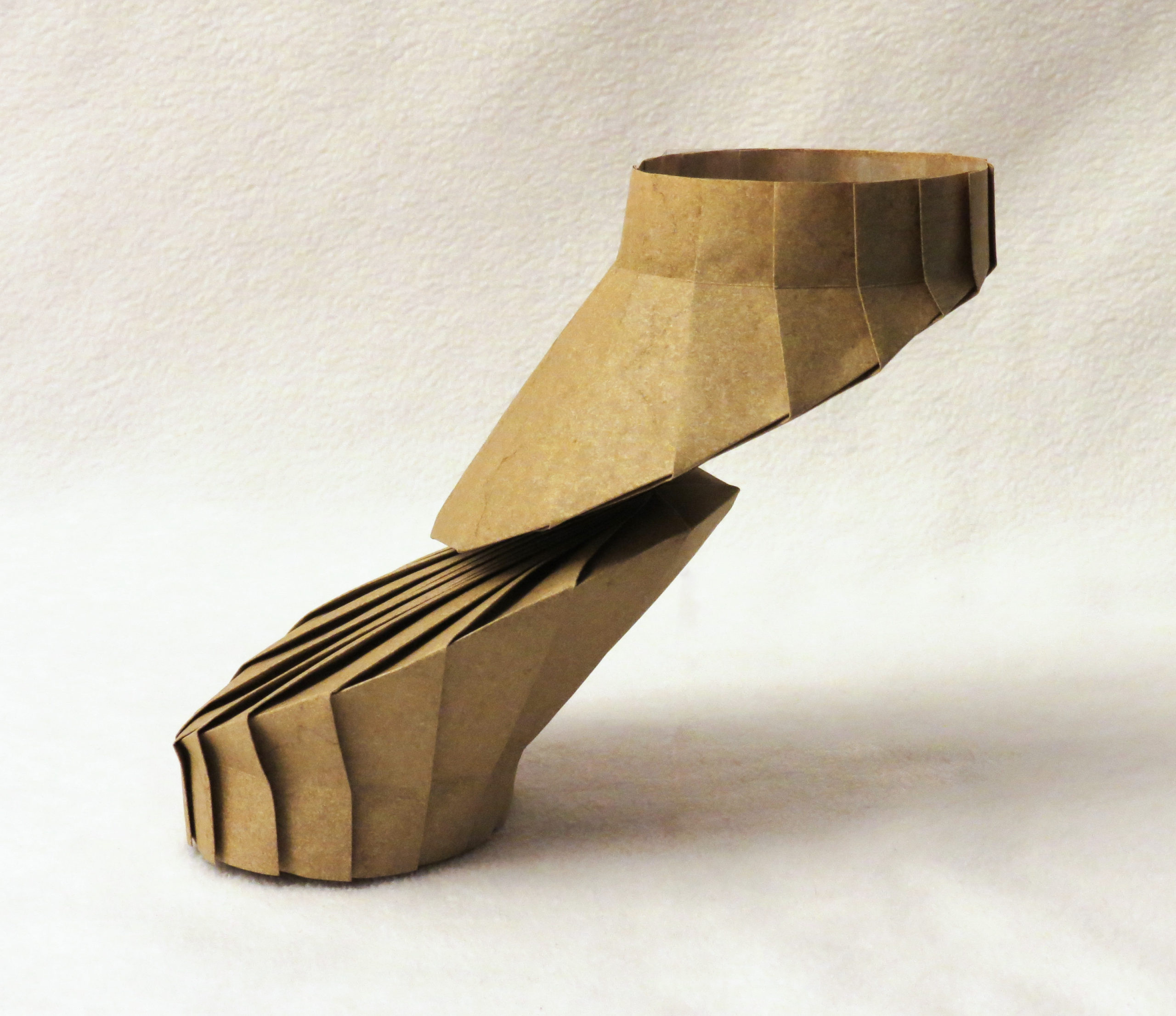
I’ve been catching up on posting pieces that are currently on display at the Urbandale Art Gallery, and this is the last of those pieces. This piece continues my diagonal shift series and builds on a recent test fold. I continued the theme of cone-based diagonal shifts here, putting the test fold into practice in a finished piece. One of the challenges in designing this piece was volume and balance: all of my diagonal shift vases up to this point have had shifts that naturally tend to have similar volume on either side of the shift, so it was always fairly easy to make the piece look like the top and bottom halves were proportionate. (This type of visual balance is very different from the piece looking or being physically balanced – most of my diagonal shifts include small weights in the bottom so they don’t fall over!) For this piece, the cone on the top half is a lot narrower than on the bottom half, so I had to play more than usual with height to make sure the proportions looked right. This piece ended up an inch or two taller than most of my shift vases to get that balance.

Cone-based inward/outward diagonal shift vase

New work: Cone-based inward/outward diagonal shift vase Read More »

New work: Cone-based downhill diagonal shift vase

This piece is a return to my long-dormant diagonal shift series. I played a bit before with diagonal shifts based on a cone instead of on a cylinder, along with a test fold of a diagonal shift based on an out-turned cone. Similar to my previous downhill diagonal shifts, the shift in this piece is really a stack of two bends and one shift. To get all the angles correct, the bends are cone-based bends, and the shift is based on an out-turned cone instead of an in-turned cone.

I also included a photo of the painted paper below. For most of my diagonal shifts, I’ve used sine waves for the painted patterns and let the painted lines naturally zig-zag a bit as they crossed the pleats. For this piece, since the narrowest parts of the black stripes are in places where the pleats are the widest, I incorporated zig-zags into the painted pattern. That made for a lot of measuring reference points, but it smooths out the painted lines nicely.

Cone-based downhill diagonal shift vase
Painted paper for cone-based downhill diagonal shift vase

New work: Cone-based downhill diagonal shift vase Read More »

New work: Angular nesting bowls

I’m continuing to share some of the pieces currently on display at the Urbandale Art Gallery. This nesting piece builds on the lacy series, but shifts the visual language from curves and circles to sharp angles and triangular forms. As with the circular nesting bowls, this work is composed of four separate pieces that nest together and function as a single object. The triangular cutouts echo the sharp outward angles in the bowl and vase forms. Unlike the circular vases, where gradient from light to dark tended to highlight the distinctions between the forms, these pieces gradient from dark to light. This enhances the unity between the forms because the contrast between the outer, darker piece and the inner, lighter piece viewed in partial shadow is small. The color gradient and the angularity suggests flame-like imagery. Together, the four pieces form a cohesive object defined by repetition, contrast, and gradual transformation.

Angular nesting bowls

New work: Angular nesting bowls Read More »

New work: Circle nesting bowls

I’m catching up on posting some of the pieces that are currently on display at the Urbandale Art Gallery. This piece continues the theme of my lacy series, with the new twist that this piece is really four separate pieces that nest. The shapes of all four bowl/vase forms echo each other but become taller and narrower for the inner pieces. The color also follows a gradient from light to dark, giving a sense of continuity while also clearly showing the distinctions between each of the four pieces. Together, the four component pieces function as a single object unified by a gradual progression. Individual photos of the component pieces are below.

Circle nesting bowls
Circle nesting bowl 1
Circle nesting bowl 2
Circle nesting bowl 3
Circle nesting bowl 4

New work: Circle nesting bowls Read More »

New work: Black and white lacy vase 2

This piece is another slightly simpler lacy vase, similar to my most recent piece. In this piece, I continued playing with the contrast between the plain white surface of the paper and the black lacy panels.

The wavy lines in this lacy pattern look fairly freeform, but this was actually one of the trickier lace patterns I’ve done to lay out in a way that actually worked. It was tough to get a balance where there was good variation in the waves so the pattern didn’t look too repetitive, but still avoiding having cutout areas so large that it would be difficult for me to get the lace panels to cooperate while folding. It took me a few rounds of drawing and erasing the lines to find a balance I was happy with.

Black and white lacy vase 2

New work: Black and white lacy vase 2 Read More »

New work: Black and white lacy vase

Another piece in my series of lacy vases. After a bunch of increasingly complicated models, I decided to pare things back. This vase only has only a handful of straight-line folds, and the entire surface of the paper is visible (except for the base). The model is square at the top and bottom and octagonal in the middle, and I used the angled panels transitioning between the two as black lacy contrast panels. I like the simplicity here where the lace pattern is able to stand out more, as a contrast to my more complex pieces where the lace is one of many design elements.

It’s a little tricky to see, but the view of the inside gives a bit of a view of how I created the lace. For this pattern, I drew curved lines with a pencil, erasing and re-drawing until I was happy with the overall pattern. Then, I cut out the areas between the drawn lines, leaving ~1 mm margin between the pencil line in the middle and my cut line. That means the black lines that are left after the cutting are ~2 mm wide. I like leaving the traces of my work process on the inside of the vase as reminder that this is all handcrafted and not machine-made.

Black and white lacy vase

New work: Black and white lacy vase Read More »
New work: Blobby lacy vase

Continuing in a similar vein as my last few pieces, this model has solid shapes with lace cut in between them. I used a similar approach of sketching the outlines of the solid blobs on the partly folded model so the lines matched up correctly. The big change in this piece is that the lace is based on curved lines that mimic the shapes of the blobs. The folded shape of the vase also mimics the curves of the lace.

Blobby lacy vase

New work: Blobby lacy vase Read More »